

Strategic Roth Conversions

Strategic Roth Conversions: A Physician's Guide to Potential Tax-Free Retirement Wealth in the Carolinas
Executive Summary
For successful physicians in South and North Carolina, years of maximizing pre-tax retirement accounts like 401(k)s and Traditional IRAs has the potential to create a significant, looming tax liability. This guide introduces the strategic Roth conversion as one vital solution, detailing how timing, tax bracket management, and funding sources may transform a future tax burden into long-term, tax-free retirement wealth.
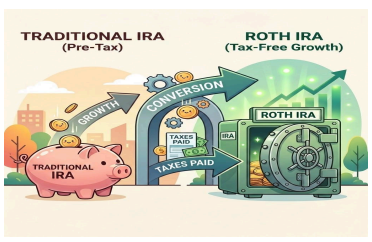
What is a Roth? Key Terms Defined
Roth Accounts (IRA, 401k)
A Roth IRA is retirement account funded with after-tax dollars. You pay the tax now, but all future growth and qualified distributions are completely tax-free forever.
Basic Conversion & Risks
A Roth Conversion is the process of moving pre-tax money from a Traditional retirement account (like a Traditional IRA or 401k) into a Roth account. (Ameriprise Roth Article) The amount converted is treated as ordinary taxable income in the year of conversion. Therefore, in that year, the investor will often experience a higher AGI and potentially jump into a higher marginal tax bracket. There are other considerations or potential risks beside the immediate tax hit. The 5-year rule applies: in order to avoid a 10% early withdrawal penalty, an investor must wait a minimum of five years from the beginning of the tax year of the conversion before withdrawing the converted principal. Also, under current tax law, a Roth conversion is permanent; it cannot be re-characterized. (Vanguard Roth Article) The Backdoor Roth The Backdoor Roth is a maneuver utilized by some high-income earners (HCEs) who exceed the income limit for direct Roth IRA contributions. (Vanguard Back Door Roth Article)
The Backdoor Roth
The Backdoor Roth is a maneuver utilized by some high-income earners (HCEs) who exceed the income limit for direct Roth IRA contributions. (Vanguard Back Door Roth Article)
1. Contribute post-tax dollars to a Traditional IRA.
2. Immediately convert that contribution to a Roth IRA
The Mega Backdoor Roth
The Mega Backdoor Roth is a strategy available to employees whose 401k plans allow after-tax non-Roth contributions. It involves contributing after-tax money to the 401k and then immediately converting (or "rolling") it to a Roth 401k or Roth IRA. (Fidelity Mega Backdoor Roth Article) A limitation to the Mega Backdoor Roth strategy is that an investor’s workplace plan must permit not only after-tax
contributions, but also in-service withdrawals (moving money out of the plan while still employed by the firm) of those after-tax contributions. For those whose workplace plans meet these criteria, the Mega Backdoor Roth also requires careful administrative management to avoid tax issues regarding earnings of the contributions. (Edelman Financial Mega Backdoor Roth Article)
The Conversion Decision
A Tale of Two Doctors (a hypothetical scenario)
To illustrate the dramatic impact of a proper Roth conversion strategy, let's consider two successful 55-year-old physicians, pediatric endocrinologist, Dr. Polly Palmer, and orthopedic surgeon, Dr. Ollie O'Brien, both with approximately $2 million in pre-tax retirement accounts.
Financial Assumption | Detail |
Current Tax Rate (55-59 yo) | Highest Marginal Bracket (~40%) |
Planned Retirement Age | 60 |
Investment Returns (Assumed) | 7% |
Goal | Maximize after-tax wealth at age 80 |
Dr. Palmer: The Strategic Converter
Our fictional Dr. Palmer, “Polly the Pediatrician,” waits until she retires at age 60, putting her in a significantly lower marginal tax bracket (for this example, assumed to be an effective 24% during conversion years 60-64). Crucially, she uses external funds from her taxable brokerage account to pay the tax bill on the conversion.
● Strategy: Convert in a lower tax bracket (Ages 60-64) and pay taxes from outside funds.
● Result: The entire $2 million conversion and its subsequent growth compounds tax-free.
Dr. O'Brien: The Common Mistake
Our fictional Dr. O'Brien, “Ollie the Orthopedist,” converts while still working (Ages 55-59) in the highest marginal 40% tax bracket. To make matters worse, he uses internal IRA funds to pay the tax bill.
● Strategy: Convert in the highest tax bracket (Ages 55-59) and pay taxes by withdrawing from the conversion amount itself (internal funds).
● Result: He pays higher taxes and, by using IRA funds to cover the tax, reduces the amount that compounds tax-free in the Roth account.
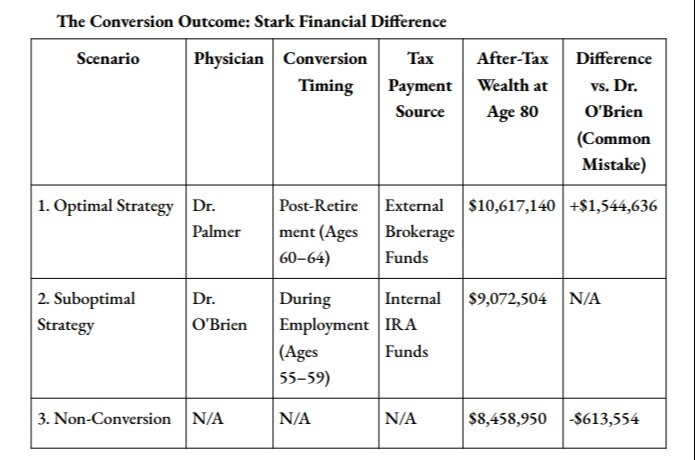
The Bottom Line: By executing the conversion strategically (lower tax bracket + external tax payment) in our hypothetical scenario, Dr. Palmer yields over $1.5 million more in after-tax wealth compared to Dr. O'Brien's common, costly mistake. Furthermore, converting is essential, as even the flawed conversion strategy yielded more wealth than doing nothing (Scenario 3. “Non-Conversion” above).
Conversion Strategy by Career Stage
Our Opinion @ Maguire Investment Management (IM)
1. Early Career (The Low-Bracket Advantage)
● Situation: Physicians in residency, fellowship, or early practice often have
relatively lower income, but have not yet started significant pre-tax savings.
● Strategy: Consider utilizing the lower tax brackets (0% or 12%) by converting
small amounts from any existing Traditional IRA/401k to a Roth annually.
Maximize Backdoor Roth contributions when possible.
● Pearl: Pay minimal tax now for decades of tax-free growth. The early converted
dollar is the most valuable dollar you will ever save.
2. Midcareer (The Strategic Pause)
● Situation: Peak earning years mean you are in the highest marginal tax bracket.
Converting now is usually quite expensive.
● Strategy: Focus on maxing out pre-tax retirement accounts (401k, 403b, etc.)
to reduce current taxable income. Continue using the Backdoor Roth for new
annual contributions as able.
● Pearl: In general, only convert during this stage if you experience a specific,
temporary income dip (e.g., sabbatical or extended leave). Otherwise, defer
taxes.
3. Late Career/Retirement (The "Gap Years" Strategy)
● Situation: Looming Required Minimum Distributions (RMDs) at age 75 and
the realization of a massive future tax problem.
● Strategy: Implement the "Gap Years" approach is generally the wisest
approach, as demonstrated by Dr. Palmer's excellent outcome in our
hypothetical scenario. Retire before RMDs begin (age 75) and before Social
Security starts (age 65-70), if that decision fits with your lifestyle choice. This
strategy creates a period of low-to-mid taxable income (the "Gap Years").
● Pearl: In general, try to fill up lower tax brackets (e.g., converting only enough
to stay within the 22% or 24% federal bracket ideally). Always pay the tax bill
using external, non-IRA funds to maximize the amount compounding
tax-free.
Conclusion
Roth conversions are a powerful potential tool in the physician's financial arsenal,
but the timing, investor marginal tax bracket, and tax funding source are critical.
Getting it wrong, as Dr. O'Brien discovered in our hypothetical example, may cause
significant harm to your post-retirement wealth.
Maguire IM specializes in guiding physicians and other high-earning professionals
through these complex decisions. We provide two types of investment services: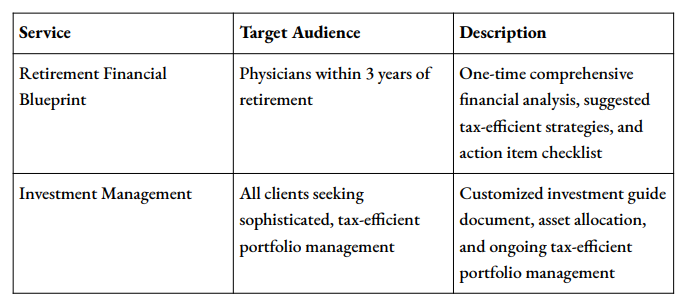
Contact us today to discuss your retirement strategy.
Let’s write your RX for financial health together!