

What is Direct Indexing: A Tax-Efficiency Guide for Physicians and Other High-Net-Worth Investors

What is Direct Indexing? A Tax-Efficiency Guide for Physicians and Other High-Net-Worth Investors
Executive Summary
Direct Indexing (DI) is a sophisticated investment strategy where you own the individual stocks within an index directly, rather than shares of an ETF or mutual fund. This granular ownership allows high-net-worth (HNW) investors to perform tax-loss harvesting (TLH) with individual underperforming securities to offset capital gains elsewhere in their portfolio. This strategy has the potential to generate significant tax-efficiency, even when the broader market is trending upward.
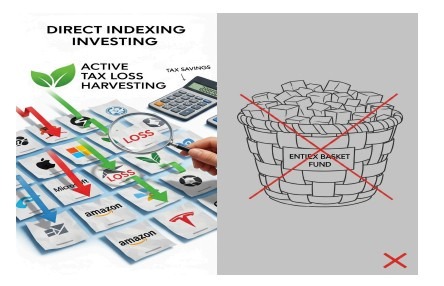
● Enhanced Tax-Loss Harvesting (TLH): Capture individual stock losses to offset capital gains, significantly reducing your annual tax liability compared to traditional ETFs or mutual funds.
● Superior Tax Alpha: Potentially generate "tax alpha"—excess after-tax investment returns—by actively managing portfolio losses regardless of broader market performance.
● Granular Customization: Exercise precise control over your portfolio by excluding specific companies to manage concentration risk or align investments with your personal values
How can I lower my capital gains taxes during a bull market?
Investors may encounter a real challenge during sustained bull markets: significant capital gains without realized losses to offset their tax liability. For HNW investors wanting or needing to sell stocks with significant capital gains, TLH is an extremely helpful tool. Tax-loss harvesting is the practice of selling investments at a loss to offset capital gains realized from the sale of profitable investments, thereby reducing your overall tax liability. (Vanguard TLH Article)
Unfortunately, for HNW investors holding mostly ETFs and mutual funds, the uniform rise of the overall fund means finding areas for TLH can be quite challenging. Lots of gains with few or no losses is a nice problem to have for sure, but a potentially costly issue nevertheless! Direct Indexing offers a strategic solution to this challenge.
How does Direct Indexing function as a strategy?
Direct Indexing replaces pooled ETF shares with ownership of the underlying index constituents. This granular structure enables algorithmic TLH, which generates "tax alpha"—excess after-tax return—by capturing losses on individual stocks, even when the broader market index rises. By continuously monitoring holdings for these opportunities, DI turns market volatility into a persistent tax-efficiency advantage.
What are the primary advantages of Direct Indexing for physicians and other high-net-worth professionals in the Carolinas?
High-net-worth professionals benefit from DI through the generation of measurable tax alpha and granular control over portfolio exclusions. For HNW investors, particularly high-earning physicians, DI with active TLH is a powerful financial tool that goes beyond simple tax deferral:.
1. Generating Measurable Tax Alpha
Academic and industry research strongly supports the potential for DI with active TLH to generate significant tax alpha—excess investment returns attributable to proactive tax management. In “Tax-loss Harvesting: Why a Personalized Approach is Important,” Vanguard authors Paradise, Khang, & Dixon reveal that active TLH within a DI framework can yield tax alpha ranging from approximately 0.47% to 1.27% (47 - 127 bps) annually. (Vanguard TLH: Personalized Approach Article) Similarly, a paper from MIT authors Chaudhuri, Burnham, and Lo, “An Empirical Evaluation of Tax-Loss Harvesting Alpha,” that studied 500 large cap securities from 1926 to 2018 revealed that active TLH yielded a tax alpha of 0.85% (85 bps) when constrained by the wash sale rule. (MIT TLH Alpha Article) These tax alpha numbers are significant. For high-income professionals, the benefit is maximized. This important topic is one that should be discussed with your CPA or other tax professional.
2. Deep Customization and Control
Unlike pooled funds, DI offers granular control over your portfolio:
● Concentrated Position Management: Investors can exclude stocks of companies in which they hold concentrated positions, avoiding overexposure to a single stock and ensuring a truly diversified indexing strategy.
● Values Alignment (ESG): DI portfolios offer true Environmental, Social, and Governance (ESG) customization by allowing the explicit exclusion of companies or industries that do not align with an investor’s personal or professional values. (Vanguard DI Definition Article)
Is Direct Indexing the right choice for your specific portfolio?
Direct Indexing is most effective for investors in high tax brackets with substantial portfolios and long-term investment horizons. According to Vanguard and other sources, the realization of substantial tax alpha is dependent upon several factors, which typically align perfectly with the profile of a successful physician in mid or late career:
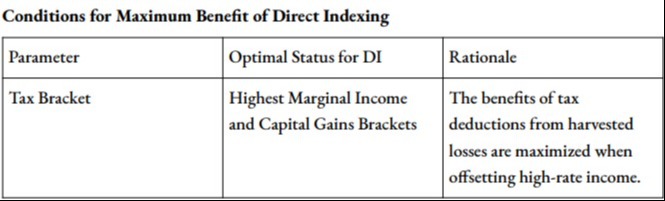
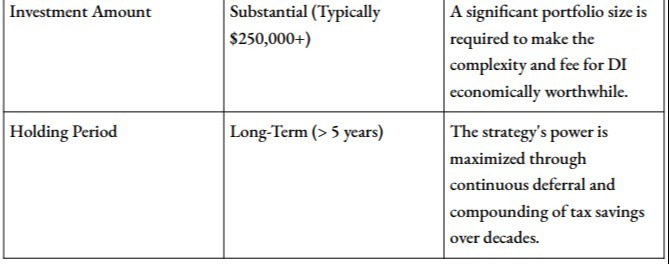
(Vanguard DI Selection Article)
What are the risks and mitigating factors of this strategy?
According to Vanguard authors, Paradise, Khang, and Dixon, the primary risks include mechanical wash sale violations and long-term cost-basis ossification, both of which can be managed through systematic oversight. While DI offers compelling advantages, sophisticated investors must be aware of the mechanical and long-term considerations:
1. Mechanical Risk: The Wash Sale Rule
Active TLH must strictly adhere to the IRS Wash Sale Rule. This rule disallows a loss if an investor purchases a "substantially identical" security within 30 days before or after the sale date. (Fidelity Wash Sale Article) DI mitigates this risk by immediately purchasing a similar but not identical stock. This systematic approach ensures the portfolio remains fully invested and continues to track the target index without triggering the penalty
2. Long-Term Risk: Ossification
A long-term risk of aggressive and successful TLH is ossification, or the diminishing returns of the strategy over many years. When losses are successfully harvested, the cost basis of the remaining holdings is incrementally lowered. Over decades, this process can accumulate stocks with an extremely low cost basis, creating substantial built-in capital gains that may make you reluctant to sell due to the resulting tax liability. At Maguire Investment Management (IM), we integrate DI into a comprehensive financial plan, ensuring this liability is proactively addressed (e.g., via charitable donation or transfer at death, which provides a step-up in basis).
Pricing Comparison: Direct Indexing (DI) Custodial Fees (2026)
Provider Annual Fee (bps) Sources
Fidelity 40 Fidelity Managed FidFolios
CharlesSchwab 40 Schwab Personalized Indexing Product Page
Vanguard 20 Vanguard Advisor Portal
Altruist 12 Altruist Personalized Indexing Info
*Note: These fees are estimates and can vary based on platform-specific terms, assets under management, and account minimums.
Tax-efficient Investing with Maguire IM?
With Maguire IM, investors may choose between our two services, both of which include a focus on tax-efficiency:
● Investment Management: This comprehensive, ongoing, AUM-based service leverages DI with active TLH for suitable clients in high marginal tax brackets.
● Retirement Financial Blueprint: This one-time blueprint service with project-based fee designed specifically for physicians within three years of retirement includes tax efficiency strategies to optimize your life transition.
Conclusion
At Maguire IM, we specialize in managing the unique financial complexity generally faced by physicians and other high-earning professionals in the Carolinas. Whether you are actively building wealth or approaching the final years of your career, we can integrate this strategy to potentially enhance your long-term returns.
Schedule a time to chat with Maguire IM about whether DI with active TLH is a solid strategy for you.
Let’s write your RX for financial health together!